

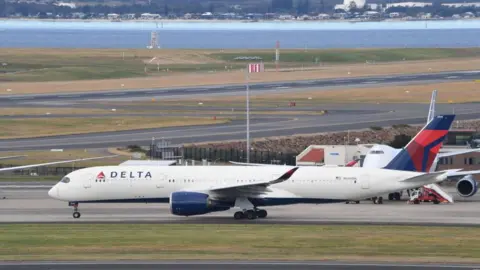
Several people were hurt when a Delta flight originating in Los Angeles to Sydney was hit by rough air this past Friday.
Flight DL41 "encountered brief turbulence" as it landed at Sydney Airport, a company official informed. A number of the onboard staff sustained injuries.
The New South Wales Ambulance Service reported they evaluated five individuals, and transported a trio to the hospital with relatively minor issues that such as spinal discomfort and migraines. The injured ranged from their 30s up to the 70s.
This marks the newest example of commercial jets being hit by severe turbulence, with researchers pointing out that global warming is a major factor.
There were 245 people and 15 crew members on the aircraft, the official noted, stating that the plane touched down "safely and normally" at the airport at 06:48 local time on the day in question.
Emergency responders said they received a call just only 180 seconds ahead of the plane touched down, and ambulances were standing by on the runway.
The reasons turbulence is growing increasingly prevalent - and more severe.
During the past year, 25 people were hurt when a separate Delta aircraft, on a route from Salt Lake City, Utah to Amsterdam, Netherlands, experienced "significant" rough air just 120 minutes into the long-haul flight, and had to make an precautionary landing.
In 2024, those on board on a Singapore Airlines flight endured a terrifying short but intense of severe turbulence. An individual lost their life and dozens were injured, as individuals not fastened in were thrown from their seats and fell back down.
Bumpy air is not uncommon on aircraft journeys, and while instances of strong or severe turbulence seem to be rising, they are remained quite uncommon.
Estimates show that there are an estimated five thousand cases of severe-or-greater turbulence every year, out of a sum of more than 35 million journeys that now take off worldwide.
Severe turbulence is defined as when the vertical motions of a jet experiencing rough air masses apply greater than 1.5g-force on your body - enough to throw you from your seat if you weren't wearing a seatbelt.
As global warming shifts atmospheric conditions, researchers alert that commercial aviation could become bumpier: shifts in temperature and shifting wind patterns in the upper atmosphere are likely to increase the frequency and intensity of dangerous in-flight bumps.

